Showing posts with label Boston. Show all posts

Boston's New Museum Of Fine Arts Wing Helpfully Reveals Museum Weaknesses

Art review: The Art of the Americas wing at the Museum of Fine Arts Boston


MFA Meso American

BOSTON -- In 1994, a museum wave began to surge in Dallas. This weekend it breaks on a Massachusetts shore.


Saturday the Museum of Fine Arts Boston opens an impressive, $345-million new wing to display the Art of the Americas. The transformation, 11 years in the making, is dramatic.

The Dallas Museum of Art was the first to take a post-colonial view of the subject of American art, starting the chronology not with the European settlement of the New World, as museums traditionally had, but with ancient civilizations spanning North, Central and South America. Sophisticated indigenous and pre-Columbian civilizations had been around for thousands of years before Jamestown and Plymouth Colony.

Shifting focus toward the continents where the art was made, rather than to the history of today's dominant culture, had the benefit of clarifying the transitory ebb and flow of political power over time. Many museums, including the Los Angeles County Museum of Art, have since followed suit, beginning their American art displays in ancient Mesoamerica.

But Boston's, thanks to geography, ranks as perhaps the most decisive change. MFAB, founded five short years after the Civil War, is located in an epicenter of the American Revolution. It has always been synonymous with older, more hidebound ideas of what is American about American art.

When a collection boasts more than four dozen paintings by John Singleton Copley, including his iconic 1768 portrait of Paul Revere, how could it not be?

MFAB courtyard into galleries

And that's not the half of it. The new galleries are reached by an immense, 63-foot-tall, glass-walled interior courtyard -- essentially a vast party space, rather chilly in its corporate sleekness (London's Norman Foster is the architect) -- which roughly duplicates the size and scale of the exhibition building adjacent.

The second and third floors of the new four-story wing, which boasts 51,000 square feet of space in 53 galleries, houses the museum's well-known collections of Colonial, Revolutionary and 19th century paintings, sculptures and decorative arts. Although primarily limited to the Northeastern U.S., the depth is exceptional.

First comes the museum's Ur-object: Revere's famous "Sons of Liberty Bowl," a simple footed shape, like a little punch bowl, in finely engraved silver hollow-ware. On the wall behind it is Copley's marvelous portrait of the silversmith-patriot. In the brilliant image, where Revere holds a teapot in one hand and his chin in the other, Copley fuses head with hand as implements of thought, labor and moral action.

MFA Revere Copley

Each floor has a central spine, with rows of galleries on either side (think of a trio of parallel halls). The plan allows for serendipity in your journey, rather than a strictly linear narrative, as well as for great variation in display.

Some galleries are virtual solo or theme shows -- a room of great Copley portraits, say, or another with 33 hand-stitched needlework samplers by Sally Jackson and other young Colonial women. A salon-style floor-to-ceiling hanging of mostly Romantic landscapes and genre scenes includes Washington Allston's 1818 vision of ravens feeding Old Testament prophet Elijah in a bleak desert, the first work acquired by MFAB 140 years ago. Nearby, Luminist landscapes by Fitz Henry Lane and Martin Johnson Heade bring unearthly calm and order to the rise and aftermath of the brutal Civil War.

There are surprises. John Singer Sargent's famous pictorial answer to Diego Velazquez's "Las Meninas" is flanked by the actual colossal Japanese vases shown in Sargent's atmospheric 1882 depiction of "The Daughters of Edward Darley Boit." Some paintings hang on replicas of brightly patterned period wallpaper. A small gallery features Spanish Colonial art -- mostly on loan, alas, but anchored by a fine new purchase: a 1754 Mexican archbishop's portrait by the great Miguel Cabrera.

MFAB 004

But nothing is more surprising than the ground floor, which kicks off the wing's chronology with an unexpectedly absorbing display of pre-Columbian objects from Mesoamerica. Who knew MFAB had such rich holdings -- especially great Mayan painted vessels, as fine as anything in the building?

There's wit, too. An adjacent gallery introduces the Puritans' arrival to Massachusetts. Leaving behind highly refined pre-Columbian clay, you encounter a rough,1680s cupboard with a tin-glazed earthenware British plate featuring the florid inscription, "Welcom [sic] my Friends, 1661." Welcome, indeed: The clash of the Europeans' arrival in the New World looms.

There are some significant problems, such as poorly displayed Colonial and 19th century furniture vignettes upstairs. MFAB has great decorative objects, lined up against walls. But shin-high strips of object labels inexplicably obscure the carefully crafted feet and lower registers of elaborately carved chairs, tables and chests. Like the graphics Chyron running at the bottom of a TV screen, the labeling is more intrusive than helpful.

MFA 20th century

Still, the biggest fiasco is the fourth floor. A flatly dreadful selection of 20th century, mostly New York art, often badly installed, gives testament to MFAB's long-standing reputation -- which it wants to shake off -- for conservative disinterest in the complexities of modern life. Not to put too fine a point on it, the entire 20th century needs to be re-thought, much the way the entire Art of the Americas approach has been.

One hurdle faced by reconfigured museums, including MFAB, is that existing collections reflect the "old" approach to art's history rather than the new. That means huge and inevitable gaps. The question is what to do about them.

The new clarity afforded to existing holes might give potential donors some bright ideas. Nobody wants cookie-cutter museums with uniform collections -- there's already too much of that -- even for an encyclopedic museum like Boston's, which aspires to encyclopedic thoroughness. And distinctive local flavor is to be encouraged.

But MFAB's new American wing helpfully exposes the cracks in traditional thinking about American art. Maybe those fractures will give the museum some good ideas on how to represent art's 20th century.

-- Christopher Knight

Art of the Americas, Museum of Fine Arts Boston, 465 Huntington Ave., Boston, (617) 267-9703; www.mfa.org

Photos: Mesoamerican galleries; courtyard and Art of the Americas galleries; John Singleton Copley's  "Portrait of Paul Revere" and Revere's "Sons of Liberty Bowl;" Credit: Museum of Fine Arts Boston; Martin Johnson Heade's "Approaching Storm: Beach Near Newport," center, and 19th century furniture; Credit: Christopher Knight / Los Angeles Times; 20th century art galleries; Credit: Museum of Fine Arts Boston

This article is from: http://latimesblogs.latimes.com/culturemonster/2010/11/art-review-the-art-of-the-americas-wing-at-the-museum-of-fine-arts-boston.html

Boston's New Museum Of Fine Arts Wing Helpfully Reveals Museum Weaknesses

Art review: The Art of the Americas wing at the Museum of Fine Arts Boston


MFA Meso American

BOSTON -- In 1994, a museum wave began to surge in Dallas. This weekend it breaks on a Massachusetts shore.


Saturday the Museum of Fine Arts Boston opens an impressive, $345-million new wing to display the Art of the Americas. The transformation, 11 years in the making, is dramatic.

The Dallas Museum of Art was the first to take a post-colonial view of the subject of American art, starting the chronology not with the European settlement of the New World, as museums traditionally had, but with ancient civilizations spanning North, Central and South America. Sophisticated indigenous and pre-Columbian civilizations had been around for thousands of years before Jamestown and Plymouth Colony.

Shifting focus toward the continents where the art was made, rather than to the history of today's dominant culture, had the benefit of clarifying the transitory ebb and flow of political power over time. Many museums, including the Los Angeles County Museum of Art, have since followed suit, beginning their American art displays in ancient Mesoamerica.

But Boston's, thanks to geography, ranks as perhaps the most decisive change. MFAB, founded five short years after the Civil War, is located in an epicenter of the American Revolution. It has always been synonymous with older, more hidebound ideas of what is American about American art.

When a collection boasts more than four dozen paintings by John Singleton Copley, including his iconic 1768 portrait of Paul Revere, how could it not be?

MFAB courtyard into galleries

And that's not the half of it. The new galleries are reached by an immense, 63-foot-tall, glass-walled interior courtyard -- essentially a vast party space, rather chilly in its corporate sleekness (London's Norman Foster is the architect) -- which roughly duplicates the size and scale of the exhibition building adjacent.

The second and third floors of the new four-story wing, which boasts 51,000 square feet of space in 53 galleries, houses the museum's well-known collections of Colonial, Revolutionary and 19th century paintings, sculptures and decorative arts. Although primarily limited to the Northeastern U.S., the depth is exceptional.

First comes the museum's Ur-object: Revere's famous "Sons of Liberty Bowl," a simple footed shape, like a little punch bowl, in finely engraved silver hollow-ware. On the wall behind it is Copley's marvelous portrait of the silversmith-patriot. In the brilliant image, where Revere holds a teapot in one hand and his chin in the other, Copley fuses head with hand as implements of thought, labor and moral action.

MFA Revere Copley

Each floor has a central spine, with rows of galleries on either side (think of a trio of parallel halls). The plan allows for serendipity in your journey, rather than a strictly linear narrative, as well as for great variation in display.

Some galleries are virtual solo or theme shows -- a room of great Copley portraits, say, or another with 33 hand-stitched needlework samplers by Sally Jackson and other young Colonial women. A salon-style floor-to-ceiling hanging of mostly Romantic landscapes and genre scenes includes Washington Allston's 1818 vision of ravens feeding Old Testament prophet Elijah in a bleak desert, the first work acquired by MFAB 140 years ago. Nearby, Luminist landscapes by Fitz Henry Lane and Martin Johnson Heade bring unearthly calm and order to the rise and aftermath of the brutal Civil War.

There are surprises. John Singer Sargent's famous pictorial answer to Diego Velazquez's "Las Meninas" is flanked by the actual colossal Japanese vases shown in Sargent's atmospheric 1882 depiction of "The Daughters of Edward Darley Boit." Some paintings hang on replicas of brightly patterned period wallpaper. A small gallery features Spanish Colonial art -- mostly on loan, alas, but anchored by a fine new purchase: a 1754 Mexican archbishop's portrait by the great Miguel Cabrera.

MFAB 004

But nothing is more surprising than the ground floor, which kicks off the wing's chronology with an unexpectedly absorbing display of pre-Columbian objects from Mesoamerica. Who knew MFAB had such rich holdings -- especially great Mayan painted vessels, as fine as anything in the building?

There's wit, too. An adjacent gallery introduces the Puritans' arrival to Massachusetts. Leaving behind highly refined pre-Columbian clay, you encounter a rough,1680s cupboard with a tin-glazed earthenware British plate featuring the florid inscription, "Welcom [sic] my Friends, 1661." Welcome, indeed: The clash of the Europeans' arrival in the New World looms.

There are some significant problems, such as poorly displayed Colonial and 19th century furniture vignettes upstairs. MFAB has great decorative objects, lined up against walls. But shin-high strips of object labels inexplicably obscure the carefully crafted feet and lower registers of elaborately carved chairs, tables and chests. Like the graphics Chyron running at the bottom of a TV screen, the labeling is more intrusive than helpful.

MFA 20th century

Still, the biggest fiasco is the fourth floor. A flatly dreadful selection of 20th century, mostly New York art, often badly installed, gives testament to MFAB's long-standing reputation -- which it wants to shake off -- for conservative disinterest in the complexities of modern life. Not to put too fine a point on it, the entire 20th century needs to be re-thought, much the way the entire Art of the Americas approach has been.

One hurdle faced by reconfigured museums, including MFAB, is that existing collections reflect the "old" approach to art's history rather than the new. That means huge and inevitable gaps. The question is what to do about them.

The new clarity afforded to existing holes might give potential donors some bright ideas. Nobody wants cookie-cutter museums with uniform collections -- there's already too much of that -- even for an encyclopedic museum like Boston's, which aspires to encyclopedic thoroughness. And distinctive local flavor is to be encouraged.

But MFAB's new American wing helpfully exposes the cracks in traditional thinking about American art. Maybe those fractures will give the museum some good ideas on how to represent art's 20th century.

-- Christopher Knight

Art of the Americas, Museum of Fine Arts Boston, 465 Huntington Ave., Boston, (617) 267-9703; www.mfa.org

Photos: Mesoamerican galleries; courtyard and Art of the Americas galleries; John Singleton Copley's  "Portrait of Paul Revere" and Revere's "Sons of Liberty Bowl;" Credit: Museum of Fine Arts Boston; Martin Johnson Heade's "Approaching Storm: Beach Near Newport," center, and 19th century furniture; Credit: Christopher Knight / Los Angeles Times; 20th century art galleries; Credit: Museum of Fine Arts Boston

This article is from: http://latimesblogs.latimes.com/culturemonster/2010/11/art-review-the-art-of-the-americas-wing-at-the-museum-of-fine-arts-boston.html
Stolen Paintings Returned After 32 Years

Stolen art’s return ends long drama


Paintings were taken from Stockbridge home


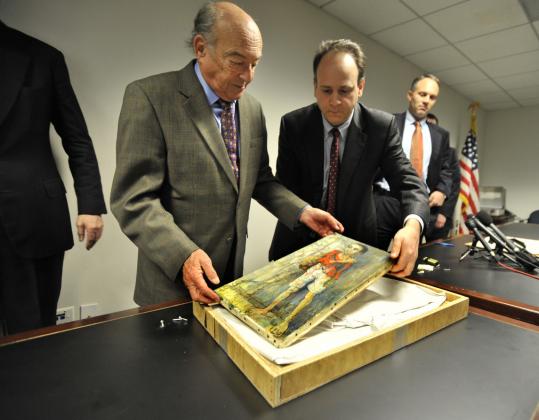
Michael Bakwin (left), and Assistant US Attorney Jack Pirozzolo, at a news conference in Boston yesterday, unpacked one of the Jean Jansem works that was stolen from Bakwin’s home in 1978.

Michael Bakwin (left), and Assistant US Attorney Jack Pirozzolo, at a news conference in Boston yesterday, unpacked one of the Jean Jansem works that was stolen from Bakwin’s home in 1978. (Josh Reynolds for The Boston Globe)


Michael Bakwin and his wife left their Stockbridge house on Memorial Day weekend in 1978 for a short trip. Soon after they returned, they discovered that someone had broken in and stolen seven paintings together worth millions, including a major still life by Cezanne. It was the costliest burglary from a private residence in Massachusetts history.


Yesterday, after a saga that spanned two continents, featured characters ranging from a Pittsfield thief to a British sleuth of stolen art, and culminated in the 2008 conviction of a Watertown lawyer-turned-artist, the last two of the missing paintings were returned to Bakwin.


Federal prosecutors turned over two small works by the French artist Jean Jansem to Bakwin at the US attorney’s office in Boston. Bakwin, who bought the two paintings in Paris in the late 1950s, said he had not seen them since they disappeared 32 years ago and was grateful to get them back, even though they were the least valuable of the lot. Together, the two are worth no more than $10,000.


“My hobby was collecting art,’’ the 76-year-old man said with a catch in his voice. “When they’re taken away from you, you feel like something has left your life. It’s a big hole.’’


The two Jansems, titled “Woman Seated’’ and “Boy,’’ have been in the custody of the FBI since Robert M. Mardirosian, a retired criminal defense lawyer, was convicted in federal court in Boston in August 2008 of possessing six of the stolen paintings. Mardirosian, who is also 76 and had stopped practicing law to become a painter and sculptor, is serving a seven-year prison term.


After a federal appeals court upheld his conviction this year and the US Supreme Court declined to consider further appeals, prosecutors were able to return the two Jansems.


Bakwin got the other five paintings back earlier and sold the Cezanne titled “Bouilloire et Fruits’’ in December 1999 for $29.3 million at Sotheby’s.


“Often, we’re here to deliver bad news,’’ Jack W. Pirozzolo, the first assistant US attorney, told reporters and photographers gathered in front of the paintings. “Today, we’re here delivering very good news.’’


All seven paintings, most of them post-Impressionist, had adorned a room in the house of Michael Bakwin and his wife, Doris, who died six years ago.


The highly publicized theft was so devastating to the family, Michael Bakwin said, that he, his wife, and their children moved to Ossining, N.Y., within a year.


According to evidence presented at Mardirosian’s trial, a client of his, David Colvin of Pittsfield, stole the artwork and then left them in the lawyer’s Watertown office.


Mardirosian had the paintings when Colvin was shot to death in February 1979 by two Boston men who had come to his home to collect on a debt.


Mardirosian kept the artwork in Massachusetts until 1988, when he moved it out of the country and eventually to a Swiss bank, prosecutors said. He was able to keep his possession secret through a variety of means, including creating a Panamanian shell company called Erie International Trading Co.


Mardirosian tried to move the paintings to London for sale, prosecutors said. But an investigation by the Art Loss Register, a London-based company that maintains a database of stolen artwork, determined that the artwork was stolen.


The company, which is headed by a hunter of missing art named Julian Radcliffe, contacted Bakwin and brokered an agreement in October 1999 with Erie for return of the Cezanne in exchange for relinquishing claims on the remaining six paintings, prosecutors said. The six were valued together at about $1 million.


Two months later, after getting the Cezanne back, Bakwin auctioned it through Sotheby’s in London.


In April 2005, Mardirosian had four of the remaining six paintings transferred from Geneva to Sotheby’s London auction house in preparation for a sale.


But Bakwin, with the help of the register, filed a suit to void the 1999 agreement and halt the sale. The lawsuit and public disclosure of Mardirosian’s name in connection with the paintings prompted the federal investigation that led to his surrender to federal authorities in 2007.


It took the jury about three hours to convict Mardirosian of possessing six stolen paintings.


Radcliffe, who stood next to Bakwin at the US attorney’s office yesterday, said the saga shows that “art crime doesn’t pay’’ and that hunters of stolen artwork “should never give up.’’


Bakwin has drawn his own conclusions. He now believes that individuals should not own extraordinarily valuable masterworks such as the Cezanne. It is too easy for such artwork to be stolen or destroyed by fire.


“It’s too much responsibility to have something like that,’’ he said.


The Jansems are another matter, he said. Asked whether he intends to hang them in his house in Ossining, he replied, “Yes, probably.’’


Saltzman can be reached at jsaltzman@globe.com.


© Copyright 2010 Globe Newspaper Company.