
The museum-building boom continues
What's happening at the Gardner and at Harvard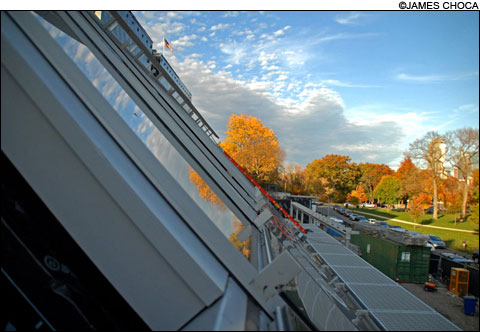
The opening of the $345 million Art of the Americas Wing at the Museum of Fine Arts this week represents but the latest — and the biggest — crest in a wave of new-museum construction in Boston that began unofficially with the opening of the new Institute of Contemporary Art building on Fan Pier in December 2007. Down the street from the MFA, the Isabella Stewart Gardner Museum is in the midst of its own $114 million construction of a new wing by Pritzker Prize–winning architect Renzo Piano. (See photos from the June "Topping Ceremony" here.) Keeping a lower profile — except to its immediate mid-Cambridge neighbors — is the renovation (some might say reconstruction) of the Fogg Art Museum, also designed by Piano (cost as yet undisclosed).
But first things first. The Gardner began site preparation October 9. By late 2011, it expects to complete its new 70,000-square-foot wing, which would then open to the public in early 2012. (The total area of the original 1903 building is 60,000 square feet.)
As of a few weeks ago, the major features of the Gardner were coming clearly into view. The Gardner has always been limited by the stipulation in Mrs. Gardner's will that, in essence, each object in the museum must remain where she left it. Special exhibitions were always limited to a 500-square-foot gallery. The special-exhibition gallery in the new wing will be a three-story, 1500-foot room with full-length north-facing windows and adjustable ceiling, plus a small, 500-foot ante-room. The old entrance will be closed; the new one, on Evans Way, will lead into a more spacious lobby. The new wing will also include a "Living Room" orientation area, a restaurant, a gift shop, new greenhouses, and two artist residences on the second floor with atelier-like windows.
But the jewel of the new wing will be its 296-seat concert hall. Last year, when Piano spoke at the museum, it seemed that this was his main incentive for taking the job. Its capacity will be about the same as that of the Tapestry Room, the site of concerts in the historic building. But that long hall, though attractive and intimate, was never ideal for concerts — especially if you were seated more than 20 rows back. The new concert hall will have its performers in the center, surrounded by the audience on all four sides, with two rows of seats on the first floor topped by three single-row balconies.
The situation at what are now being called "the Harvard University Art Museums" is more complicated. In February 2006, Harvard announced a "comprehensive academic plan to transform facilities for teaching, research, and presentation of its renowned collections." Most immediately, that meant a complete renovation of the Fogg Art Museum building at 32 Quincy Street, which was constructed in 1927. What casual observers probably didn't realize was that this also meant the demolition of Otto Werner Hall, the adjoining structure that since 1991 had housed the collection of the former Busch-Reisinger Museum on Kirkland Street.
The Fogg has officially been closed since June 2008, during which time its various collections have been represented in the Sackler Museum down the block on Broadway.
Site preparation at the old Fogg began in January. If you've walked behind the Fogg lately, along Prescott Street, you can see what appears to be a shell of the former building, blue sky clearly visible through the windows on the top of the three-story structure. Eventually, in 2013, a new, Piano-designed structure will hold the collections of the Fogg, the Busch Reisinger (with its emphasis on Central and Northern European art, especially German-speaking countries), and the Sackler (dedicated to ancient Islamic, Asian, and later Indian Art).
The purpose of the move is to unify the collections, to make all of the art more accessible, and to integrate art more broadly into the Harvard curriculum. "We wanted to create a state-of-the-art facility that would be the single location for all three of our museums," Harvard Art Museums director of communications Daron Manoogian told me. "With the Sackler being across the street in our previous configuration, it was getting about one-fifth of the visitation of the Fogg and the Busch-Reisinger, and that's not acceptable to us." (The refusal by the city of Cambridge to grant a permit for a pedestrian footbridge from the Fogg across the street to the Sackler didn't help.)
In the new Harvard University Art Museums building, you can expect much of the gallery set-up of the old building to be familiar. And the Fogg's central courtyard will remain intact. But there will be a new entrance from Prescott Street. "What we removed in the demolition you're talking about," says Manoogian, "were all the later additions to the building that were added one at time over 80 years and were never well integrated into the original building or with each other. They all had different floor-to-ceiling heights, and they all had different circulation point to the original building and to each other."
To that end, the fourth wall of the courtyard will be opened up. "You will be able to walk straight through the courtyard from the Fogg into the new wing and vice versa. It creates a single museum facility with two entrances that you can navigate through very easily from one side to the other, from the old to the new."
The old and the new. That's a theme Foster and his team kept reiterating at the MFA's Americas Wing dedication last Friday. But you have to wonder what that relationship between old and new really is. At the MFA, the Foster partners kept talking about restoring the North-South axis that was part of Guy Lowell's original master plan for the museum in 1909. But the name I.M. Pei — the designer of the MFA's West Wing, which opened in 1981 — was never mentioned. The Arthur M. Sackler Museum, designed by James Stirling, opened in 1985. It now will now most likely serve, says Manoogian, as "future home of the art-history faculty and the fine-arts library."
Otto Werner Hall — designed by architect Charles Gwathmey, who also designed the 1992 addition to New York's Guggenheim Museum —opened in 1991, but it was beset by unusual complications in its climate-control system that eventually led to the irreparable deterioration of its exterior walls. It is now rubble.
Sometimes — as in Piano's design of the new Gardner wing — architecture is about connecting old and new. Sometimes it's about an institution evolving to meet new challenges and set new goals. And sometimes, it seems, it's about correcting past mistakes.
This article is from: http://thephoenix.com/boston/arts/111755-museum-building-boom-continues/#ixzz169FrqX6i


No comments:
Post a Comment